axis mundi
2023
Galerie Julie Caredda, 4 Rue de Miromesnil, Paris 8
"The concept of the Axis Mundi was proposed by the mythologist Mircea Eliade to describe a principle shared by the mythologies of humankind: a center defined as a place of passage and connection between the sacred and the profane, the known and the unknown, the visible and the invisible. The axis of the world is to be found in relationship, not opposition."
— Christopher Yggdre
The Enigma of Traces Tested by the Present
written by Christopher Yggdre
Art Critic and Curator
Hermine Bourdin invests the space with a coherent and compelling proposition that attests to an imaginative connection with forgotten times, vanished civilizations, and ancient cosmogonies.
She speaks of what has been transmitted beyond time, affiliations, territories, articulated languages, that which eludes intellect but will always live on through imagination. This art is so ancient that we cannot fully grasp it; it separates us from it by eighteen hundred human generations. This art, for lack of a better term, is called prehistoric art. Yet, we have an intuition that naming it thus is insufficient. The diverse body of work - drawings, sculptures, photographs, films - bears witness to a proximity with an art that could unite the symbolic and the imaginative, an art that remains enigmatic to us yet can deeply move us.
The invention of Prehistory in the 19th century paradoxically unveiled the true nature of late modernity, revealing it as a confluence of beliefs disguised as certainties, with concepts like the linearity of time, notions of progress, objectivity, and evolution being examples among many others. From the 19th century to the present day, the aura of mystery surrounding time immemorial has grown in step with the excavation of traces - artifacts and architectures - left by antediluvian civilizations. The enigma of these traces will forever resist the temptation of complete understanding, of total and finite knowledge.
Faced with them, we must accept emotion, disturbance, and vertigo as possible avenues to partial knowledge of these ancient human societies, their ways of being in the world, their cosmogonies, and their imaginaries.


The archaeology of Prehistory is a stammering or trembling. It precariously balances between rational approach and poetic intuition. It has no choice but to be carried away by the powers of imagination to humbly connect with the languages and symbols contained within the traces in the hope of partially deciphering their meaning. Each new site discovered, each artifact unearthed from the depths of the earth, each fresco uncovered contradicts the hasty conclusions of the past. Perhaps this is why prehistorians are sensitive to the relationship artists establish with the traces of Prehistoric art, which dates back more than 40,000 years and spans over 35,000 years. The exhibition Axis Mundi bears witness to a unique relationship with these traces. While sculpting these initial works, through which she aimed to capture the essence and materiality of the feminine through curved forms, solids and voids, and the suggestion of movement, Hermine Bourdin naturally turned to the sources.
Among these are the famous female figurines of the Paleolithic and Neolithic, commonly known as Venus figurines, an inaccurate label that closes off imagination and obscures the enigma with an apparent explanation. These sculptures likely belonged to a spirituality that celebrated the Feminine as the principle of life and regeneration. Hermine Bourdin found elements of meaning and proximity to her own creation in the research of the prehistorian Marija Gimbutas. Marija Gimbutas was a pioneering figure in the archaeology of Prehistory, one of the first to explore the cosmogonies and spiritualities of antediluvian human societies, rather than just their social and economic organizations. By excavating and studying numerous traces at various European sites, she hypothesized a "prehistoric goddess culture" that endured for over 25,000 years in the "Old Europe." She endeavored to decipher its images and symbols, unveiling a symbolic writing system, one of matrilineal societies living in peace and cooperation with all living beings.


Hermine Bourdin ventured into contact with these goddess civilizations in "Old Europe," including those known as Cucuteni-Trypillia, Vinča, or Minoan. She explored the ruins of their temples, studied their artifacts, and traversed their landscapes. An artist can never replace a prehistorian or archaeologist, never employ their investigative methods, and never claim a regime of truth. Hermine Bourdin knows full well that the imaginations of these goddess societies will forever retain an irreducible opacity. Her investigation is one of the senses, and her creations attest to it. The artist knows, as Maria Stavrinaki aptly puts it, that "Rather than 'made,' meaning consolidated in the past, prehistory remains to be done as an enigma of the past to be interpreted from the demands of the present."
Axis Mundi is both the name of the exhibition and that of a large goddess sculpture suspended between two columns, balanced by curves and folds. The concept of Axis Mundi was proposed by the mythologist Mircea Eliade to name a common principle in the mythologies of humanity, one of a center that defines itself as the place of passage and relation between the sacred and the profane, the known and the unknown, the visible and the invisible. The axis of the world is to be found in relation, not opposition. Not far from the Axis Mundi sculpture, a series of ex-votos, or votive statues, presents forms of the feminine linked to ancient symbolic scripts, including the spiral, triangle, diamond, circle, horn, navel, and many other signs to decipher. Matter and the relationship with it are crucial here; Hermine Bourdin molds her forms in a direct, tactile, sensory relationship with the earth, transforming it through water and fire.


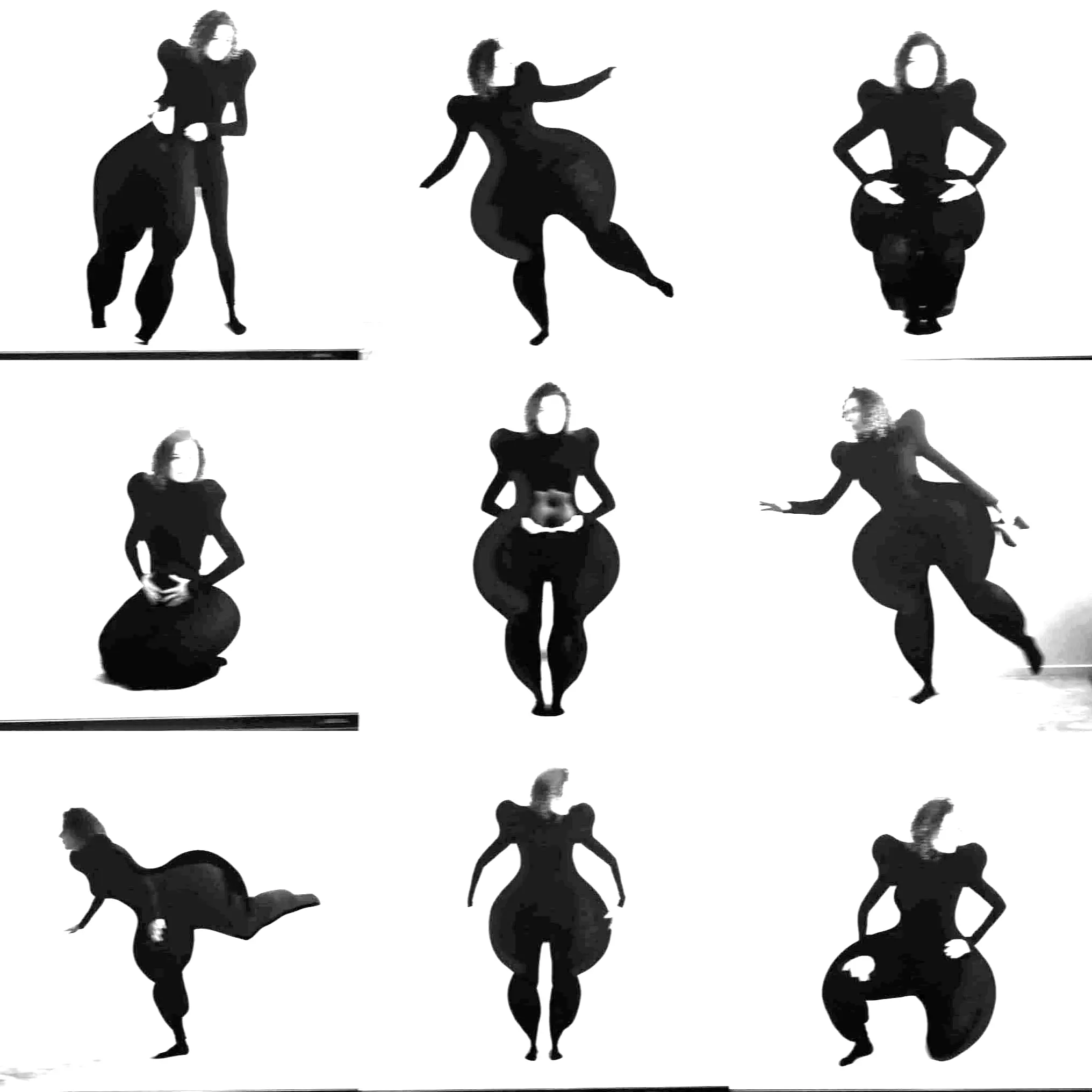
Through her elemental gesture, she seeks the formal and symbolic essence of the feminine. Graphite drawings appear as archaeological records of forms and artifacts dreamed by the artist in her quest for the feminine. Photographs document her investigation in the ruins of goddess civilization temples and performances in which she embodies the very forms she has sculpted. Her two films, "Le Ruchier" and "La Forêt," narrate two of these performances in which the artist symbolizes herself - by embracing the forms of her sculptures - in relation to the elements of nature, fauna, and flora, adopting the viewpoint of the bee or the tree, revealing possible ancient and future alliances with all living components.
Édouard Glissant taught us about communities of imagination that transcend real or assumed affiliations with our origins. This is how we should interpret his aphorism, "nothing is true, everything is alive." We must learn to renounce the temptation of the Absolute Truth to savor the impulse of the living, and thus, beyond the divisions of time and history, access narratives, knowledge, languages, writings, and poetics that may contain the clues and maps to orient ourselves differently in our threatening present. This is how the world of the goddess speaks to us here and now, not only through the enigmatic traces of the past but through the living of creation, specifically that of Hermine Bourdin.
written by Christopher Yggdre
Art Critic and Curator


The exhibition Axis Mundi bears witness to a singular relationship with these traces. It was through sculpting her early works, through which she sought to grasp the essence and materiality of the feminine through curvilinear forms, solids and voids, and the suggestion of movement, that Hermine Bourdin naturally turned toward these sources.
Among them are the famous female figurines of the Paleolithic and Neolithic, commonly known as Venuses, a misleading designation because it closes down the imagination and obscures the enigma beneath an apparent certainty.
About Marija Gimbutas
Marija Gimbutas is a pioneering figure in prehistoric archaeology, one of the first to explore the cosmologies and spiritual beliefs of antediluvian peoples, rather than focusing solely on their social and economic organization. By excavating and studying numerous traces across archaeological sites throughout Europe, she put forward the hypothesis of a “prehistoric Goddess culture” that may have endured for more than 25,000 years in “Old Europe.”
She devoted herself to deciphering its images and signs, seeking to uncover a symbolic language belonging to matrilineal societies that lived in peace and in relationships of cooperation and alliance with all living beings.
