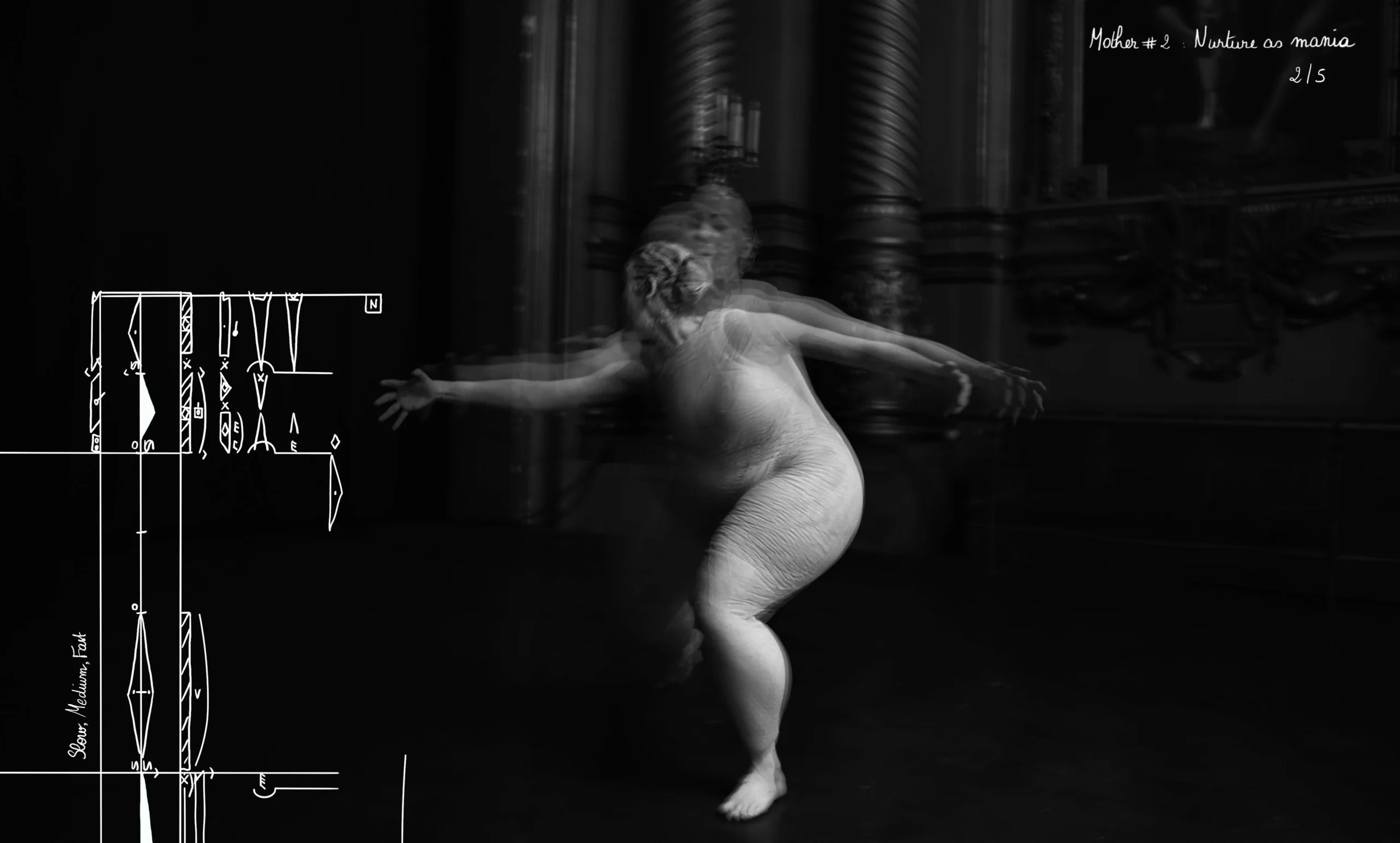
Mother #2: Nurture as mania II · Coddess Variations
Coddess Variations
Conceived by artist Hermine Bourdin, Coddess Variations (2024-2025) operates at the intersection of tangible sculpture, kinetic performance, and decentralized digital architecture. Developed in partnership with the Opéra national de Paris, the project establishes a framework for archiving ephemeral movement, marking the first instance in which choreography originating from a state cultural institution has been inscribed as an editioned collection on the Ethereum blockchain.
The work articulates a dialectic between two distinct sculptural states. During a residency within the ateliers of the Palais Garnier, Bourdin constructed a two-meter plaster monolith, its morphology referencing Paleolithic fertility figures. This static, historical anchor is activated by its kinetic counterpart—a "living sculpture" enacted by Ballet de l'Opéra de Paris dancer Eugénie Drion.

Laban Notations: CAMILLE CHAIGNE

Hervé Martin Delpierre, (Still from) Coddess Variations trailer
A fundamental aspect of this activation is the cinematic capture by director Hervé Martin Delpierre, whose imagery serves as the visual basis for the collection's digital works. Coinciding with the movement's centenary, this methodology formally pays homage to Surrealism, utilizing its techniques of juxtaposition to blur the boundaries between physical presence and virtual space.
Drion’s performance is driven by a generative choreographic system developed by the artist duo Operator. Their score structurally interprets the mythological cycles of the "Triple Goddess" (maiden, mother, crone) while introducing concepts of rest, thereby disrupting linear temporality.
By outfitting the dancer with motion-capture technology, the physical exertion of the body is translated into luminous digital vectors, effectively dematerializing flesh into code. This digital translation is deliberately counterbalanced by the inclusion of Laban notation, situating the generative algorithms within the established lineage of classical dance preservation. Comprising 100 distinct digital artifacts, the collection interrogates the nature of ownership regarding immaterial performance.
The spatial and temporal boundaries of the project are further expanded by the standalone release of Delpierre's film Under the Moon, featuring an atmospheric score performed by Christine Ott on the Ondes Martenot. Through these layered methodologies, Coddess Variations examines the ongoing tension between primordial forms and the computational structures of the twenty-first century.

Mother 2: Nurture as mania IV · Coddess Variations

Maiden 3: Sculpture flirt III · Coddess Variations

Mother 1: Should this be a solo? II · Coddess Variations

Maiden 1: Duet with zephyr V · Coddess Variations
DIGITAL COLLECTION
Explore the 100 Variations
At the intersection of sculpture, choreography, and technology, the live performance at the Palais Garnier was immortalized into 100 unique digital artifacts. Step into the interactive archive to explore the 3D models and their associated Laban movement notations.
EXPLORE THE ARCHIVEOpens in a new tab


Projection Under the Moon in Saint Elizabeth Church, Berlin
& Brunel Museum, London

Brunel Museum, London · Produced by Kiritosu Studio

Brunel Museum, London · Produced by Kiritosu Studio

St Elizabeth Church, Berlin · Produced by Kiritosu Studio
jun 4 · written by nina knaack
The poetic resonance of sculptural cinema
In Hervé Martin Delpierre’s film Coddess Variations, sculpture and cinematic narrative intertwine to explore enduring themes of femininity, mythology, and human existence – with a significant emphasis on the symbolic presence of the moon. Rather than just documenting a certain artwork, the film investigates deeper anthropological and philosophical questions, wanting to invite viewers into a reflective dialogue about their identity, (personal) transformation, and the cyclical nature of life.
The genesis
Born from Hermine Bourdin’s residence at the historic Paris Opéra, the Coddess Variations project began with a sculptural form imbued with ancient archetypes. Bourdin created a two‐meter plaster sculpture that echoes Constantin Brancusi’s idea of “material of dreams” (an interpretation of his philosophy and approach to sculpture since the artist believed that a chosen material held an intrinsic spirit and truth), conceived as a homage to the primordial imagery of prehistoric goddesses and Venus figures. Drawing inspiration from ancient symbolism, the sculpture emerged as a physical manifestation of creation myths: an invocation of those raw, original narratives that have defined the feminine mystique throughout millennia and which fascinate Bourdin.
After this first iteration process, Bourdin – in collaboration with the workshop teams of the Paris Opera – created a costume so a dancer could embody a living sculpture of a goddess. Thus, the original medium was transformed into a dynamic performance, activating and contextualizing the work as an allegory of feminine strength and sensibility.

Maiden #3: Sculpture Flirt V · Coddess Variations
Hermine Bourdin
Hermine Bourdin’s artistic journey is one deeply rooted in the ancient and the tactile. A sculptress inspired by the Paleolithic and Neolithic eras, her work spans a wide variety of mediums: from clay, stone and bronze to digital forms. For Bourdin, the act of sculpting is inseparable from the narrative of the human shape. Her deliberate challenge to contemporary beauty standards – rejecting the narrow ideal of thinness in favor of celebrating diverse and voluptuous or robust forms – positions her work as a counterpoint to modern homogenization.
From sculpture to film
Coddess Variations was initially envisioned by Bourdin as a photographic series documenting the sculpture in various forms. The project evolved when Delpierre recognized the potential for a richer, more dynamic expression through film. His approach transformed the static digital work into a fluid narrative, exploring the complexity of femininity – and the human body in general – through choreographed movements.
Hervé Martin Delpierre
Delpierre's filmmaking, characterized by introspection and poetic observation, turned out to be the perfect fit in translating Bourdin's sculpture into motion. Known for his documentaries about cultural icons like Daft Punk and the digital Cryptopunks collection + community, Delpierre's cinematic style in Coddess Variations shifted towards narrative fiction deeply embedded with symbolism. Delpierre emphasizes the project's artistic autonomy, highlighting its intention to explore existential themes without commercial constraints.

Crone #3: The Pond VI · Coddess Variations
Dance as existential expression
A living sculpture, embodied by opera dancer Eugénie Drion, acts as the dynamic counterpart to the plaster statue, illustrating the transformation inherent in the work as intended by Bourdin.
Utilizing only a wide-angle lens, Delpierre captured the expansive movements of the dancer. This choice allowed the camera to capture not only the physical embodiment of the sculpture but also the emotional depth of the dance itself, thus portraying the complexities of femininity.
The choreography, developed by Ania Catherine (Operator), was structured into nine movement vignettes to represent the three archetypes of the Goddess: Maiden, Mother, and Crone. Rejecting the linearity of these phases and their assumed ties to age, an algorithm determined the final order in which they were performed – and thus filmed.
Blockchain as the archive of movement
The imagery shot by Delpierre served as the basis for the works in the digital art collection of Coddess Variations – which consists of a series of visual pieces, alongside their corresponding choreography. The artworks utilize various mediums including sculpture, dance, video, motion capture, and Labanotation*.
Central to this collection is the ‘Operator On-Chain Generative Choreography Method’, transforming the ephemeral nature of dance into a lasting digital record by integrating smart contracts and a detailed movement library. Thus, each gesture of artistic expression has become a lasting digital inscription on the Ethereum blockchain.
*Labanotation, also known as Kinetography Laban, is a method for recording and analyzing human movement, created by Hungarian choreographer and dance theorist Rudolf Laban in the 1920s.

Maiden #1: Duet With Zephyr VIII · Coddess Variations
In praise of slowness
For Coddess Variations, Delpierre lent his distinctive cinematic language, marked by a deep reverence for the art of slow time – a deliberate, contemplative pace that allows the subtleties of human expression to unfurl. In the film, Delpierre not only visualizes the dancer’s movements, but also the silent poetry that emerges between stillness and motion. His cinematic approach here reveals a nuanced dynamic between movement and emotion, inviting viewers to pause and reflect on what he calls “the transient beauty of life.” Eschewing rapid cuts and overt dramatization, the black-and-white imagery echoes the atmospheric aesthetics of early French surrealism, particularly Jean Cocteau’s Le Sang d’un Poète, which was a key reference for Bourdin.
Bourdin worked closely with the Opéra de Paris makeup team to create the impression that the dancer was sculpted from plaster – a living statue inspired by Cocteau’s imagery and early in her process influenced by the raw, surreal vocabulary of Butoh. Though never explicitly choreographed in that tradition, its ethos informed the visual tone: a choreography of controlled, near-trance-like movements that blur the boundary between sculpture and body. This aesthetic choice adds an anthropological resonance to the film, evoking questions of identity, embodiment, and transformation – relevant in the current contemporary context, which is characterized by rapid technological change and emotional complexity.
The moon
In Coddess Variations, the moon functions as both an observer and active participant, symbolizing cyclicality, transformation, and renewal. Historically, the moon has long been associated with femininity, influencing fertility rites, mythologies, and artistic representations across various cultures. Within the film, its presence reinforces themes of constant metamorphosis, mirroring the shifting forms and emotional states of the enlivened sculpture. Anthropologically, the lunar cycle represents universal patterns shaping human experiences of life, death, and rebirth. This symbolic framework underscores the philosophical intent of Coddess Variations, inviting reflection on the cyclical nature of existence and the resonance humans feel with celestial rhythms.
Goddess
In the title, ‘Coddess’ is a deliberate and evocative play on words: a fusion of ‘code’ and ‘goddess’. It encapsulates the project’s dual identity, uniting the timeless archetype of the divine feminine with the current, new digital technology. The title thus serves as a manifesto almost, proclaiming that the essence of the goddess – her mystery, strength and perpetual allure – is here celebrated in a form of human expression and written down in code at the same time {composed in choreography, encoded in algorithmic logic, inscribed via Labanotation, and ultimately archived on the blockchain}.
Convergence
Coddess Variations is a result of the fertile possibilities that emerge when artistic disciplines intersect. It is a project that redefines the scope of sculpture, dance, digital art, and film, while maintaining a vital dialogue with the visual and mythological languages of the past.More than a documentation of a performance, the work functions as a kind of moving essay—an open-ended reflection on art as a living form. It challenges the viewer to look beneath the surface, to notice the confluences it brings forth: the enduring solidity of stone and the fluid dynamism of gesture; the archaic and the algorithmic; the poetic and the programmed. In doing so, it offers a contemplative allegory of cyclical life processes—on earth and within the self – where ancient symbolism is not preserved but reanimated through contemporary means.

credits

jun 27,2026 · written by Louis Jebb
Sculpture Meets Digital Art Under the Moon

Credit: Hervé Martin Delpierre, (Still from) Under the Moon (2025).
From an idea by Hermine Bourdin. Sculpture and costume by Hermine Bourdin. Courtesy of Hervé Martin Delpierre and Kiritosu Studio
Hermine Bourdin and Hervé Martin Delpierre discuss their film collaboration with the Opéra national de Paris
Louis Jebb
Mentioned in this article
People: Hermine Bourdin, Hervé Martin-Delpierre, Ania Catherine, Christine Ott, Eugénie Drion, Jean Cocteau, Jean-Michel Pailhon, Louis Jebb, Peter Lindbergh | Works: Coddess Variations, Under the Moon, Daft Punk Unchained, Le Sang d'un Poète, Universal Venuses, +24 more
In 2024, the sculptor Hermine Bourdin invited the film director and producer Hervé Martin Delpierre, creator of the documentaries Daft Punk Unchained (2015) and What the Punk! (2024), to make a film for Coddess Variations, a physical and digital art collection she was working on as part of a residency with the sculpture and costume departments of the Opéra national de Paris.
For Coddess Variations, Eugénie Drion, a dancer at the Paris Opera Ballet, performed choreography by Ania Catherine (of the duo Operator) in the splendidly ornate Dance Foyer of the Palais Garnier, portraying a Palaeolithic goddess who dances as a “living mirror” to a sculpture of another “Venus”, made by Bourdin in the Opéra workshops.
READ FULL ARTICLEOpens in a new tab
