DES PLIS DE PIERRE ET DE PEAU
March 26 – June 14, 2025
Galerie Julie Caredda, 4 Rue de Miromesnil, Paris 8
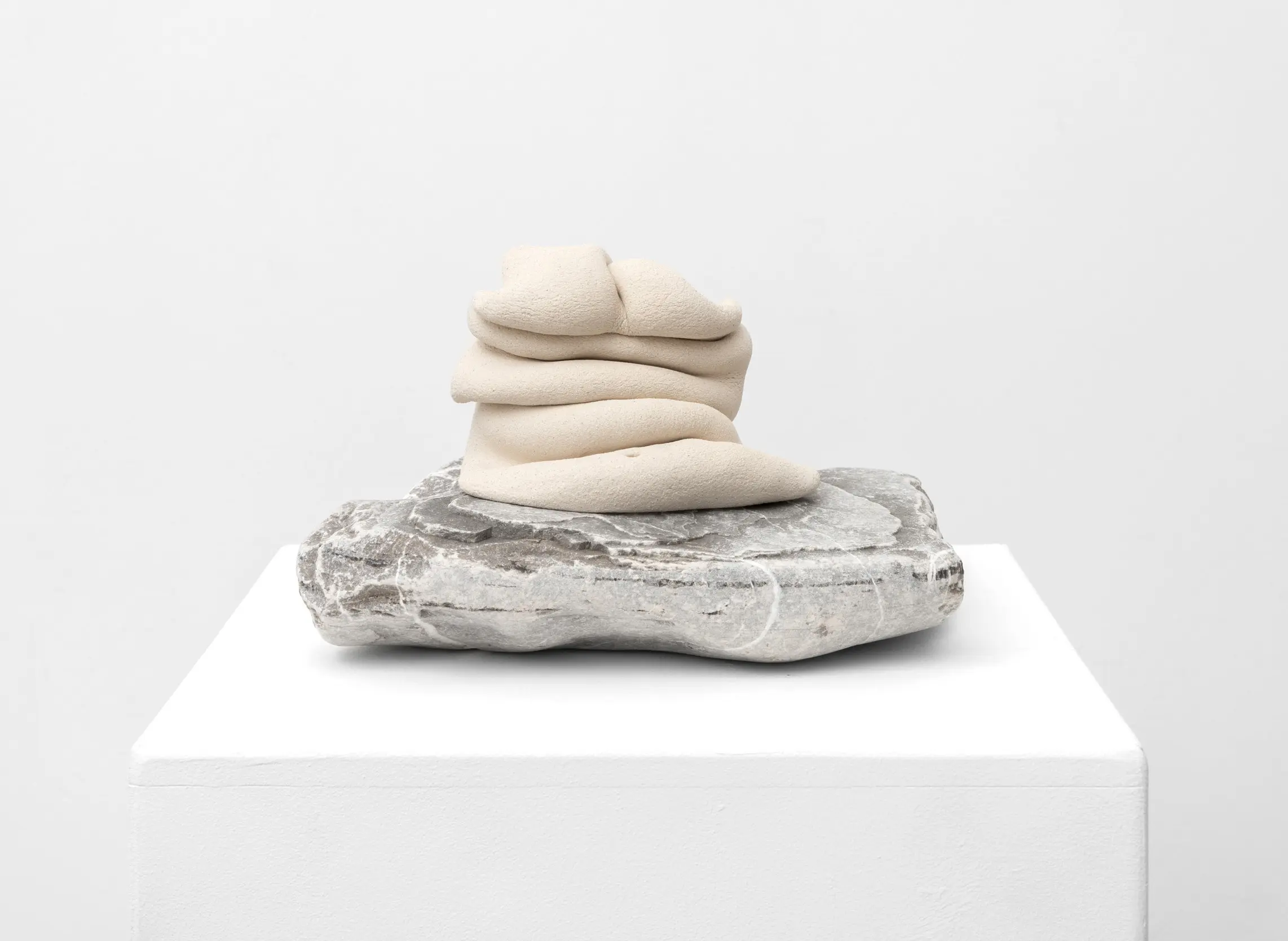
For this exhibition, I drew inspiration from the Gogottes, sandstone concretions with swirling forms, sculpted by invisible forces over thousands of years. They are its Muses. They embody an idea of the fold not as mere ornament or motif, but as a process, as an internal tension of matter.
The fold, in Deleuze’s philosophy, is the infinite movement through which the world, thought, and the subject take shape as curves in perpetual transformation, with no fixed interior or exterior. This vision deeply resonates with the Gogottes: they are not simply frozen shapes, but coiled dynamics, temporalities folded into stone, echoing skin and flesh.
written by Guillaume Logé
Art Critic and Curator
The exhibition Des plis de pierre et de peau (Folds of Stone and Skin) presents a series of sculptures, photographs, and drawings by Hermine Bourdin. In it, the female body meets the curvature of the rock, both shaped by telluric forces, signs of their belonging to the Earth. And what if, for this reason, we were to consider them through the lens of a shared aesthetics? The dialogue between the works invites us to question the determinisms of our gaze and to engage in a new relationship with beauty.
I
What could be more unreal than the sublime Pietà (1498-99) housed in St. Peter's Basilica in the Vatican? A mother holds her dying son on her lap... A mother? Under Michelangelo's chisel, she is as young, if not younger, than Christ! The woman, virginal and frozen in her youth, continues to work upon the Western imagination—and beyond. In sculpture, she is an apex of curves and folds. Our adoration is ignited by it! A miracle, indeed, is this composition where the line never ceases to undulate. Two and a half centuries later, the painter and theorist William Hogarth, in The Analysis of Beauty (1753), designated it the "line of beauty." He declared that any artist wishing to attain the Beautiful must master its secrets.
To our eyes, plant life as well as the mineral world bear its grace. Is this due to an unthought comparison with the sculptural body of classical lineage? Do we love the formal play of rock all the more because it evokes the ideal body? The affirmative is banal to point out. Idealism is situated outside of time; better yet: it hates time. At the summit of all, archetypes are as frozen as they are definitive. One cannot imagine the standard meter settling on its millimetric vertebrae, nor curving its back.
Unless one's name is Marcel Duchamp and one makes the gesture, as simple as it is revolutionary, of dropping three one-meter-long threads from a height of one meter: 3 Standard Stoppages (1913-64). What if the ideal, as a reference, offered itself in its own paradox? In other words, what if it became a nature-ideal: open, malleable—desire, that is to say, of every possible form? No dominant curve dictating the correct rules of curvature... But a living curve.
What would happen, then, if the Pietà were caught up by life? Passing from marble to flesh, she would change entirely. Yesterday, triumphing over gravity and death (extraterrestrial and inhuman); today, she would embrace the ground and the humanity that populates it. She would not be the body of an old woman, crystallizing fear and detestation, but the holder of a mystery, expressing itself further through her. She would not arouse horror, but fascination, drawing closer to that original principle which animates and carries forward becoming.
II
To say that the body participates in the making of a human being as a person sounds like a statement of the obvious—from their psyche to the extent of their social aptitudes. Three dimensions play in concert: (1) the body as an insurmountable physical given (for example, I am the height that I am), (2) the body as a receptacle of social representations and symbolism (the valorization of the slender silhouette), (3) the body as a proxy, through the feedback effect on the individual of a modification or an attribute it brings them (I put on high heels).

But this obviousness does not carry the same weight and does not function in the same way for men as for women. Latent injunctions, produced by a cultural context with multiple sources, place women in a very particular ontological relationship with their bodies. To be beautiful, permanently, according to criteria they do not choose, is a watchword around which they must find a balance throughout their existence. Such is, in any case, a generalization from which it is good to reflect. Starting by asking to what extent society thus appropriates women's bodies, and, by extension, frames their capacity to be.
Reclaiming power over one's body is a fundamental objective of feminism. It carries no prescription (aiming precisely to free itself from all of them). Its ambition has the contours of a freedom in which each woman chooses what she wishes for herself. No femininity can claim to be more legitimate than another. The realm of possibilities opens up, synonymous with an unrestricted horizon of being. One comes to dream that each woman defines, in complete independence, how she wants to make herself present, for herself and for others.


III
The question of the gaze arises—again and always, central to the fields of humanism and ecology, which are one and the same. On the gaze depends the creation of the world, of the other, and of oneself. To this self, it has the capacity to bring being, power, and joy. A triad that asserts itself as a necessity at a time when threats are raging and call for commitment. This has, moreover, been at the heart of eco-feminism since its emergence in the 1980s.
The gaze would benefit from being considered as a commons, of an even more essential importance in the face of unprecedented processes of dehumanization that are reaching unprecedented scales, driven by both technological and political hubris. From this perspective, the conditioning of bodies is grave, not only in that it reduces the amplitude, if not the very realization of our beings, but also in that it tends to sever our belonging to the Earth.
What are we to understand, then, in the dialogue between the curves of the rock and those of the female body? That a thread connects them, if one bothers to look. If seeing endows itself with a capacity to detect the subtle affinities that tie us to the common momentum of life. That of nature, an artist in its genius of stone as in that of flesh. The mountain breathes while our lungs inflate. Beauty, as Hogarth had guessed, indeed lies in this curvature that identifies us with the infinity of nature. A nature not bound by some opposition to "culture," but in perpetual invention. A nature that is not afraid of the absence of norms and welcomes the sacred, whose meaning it reformulates.
We believed that the "Venuses" of past millennia were made of stone... We ejected them into transcendence by sticking a goddess name on them... They were indeed of stone, yes, but also of flesh; more precisely, a triple alliance: being, flesh, and stone, through which one chooses to understand, today, that humanity can only find its point of fulfillment by engaging in a revolution of the gaze, by feeling the life force at work in the diversity of curves, by loving the Pietà even more beautiful for the fold of her years and her lived intimacy with the Earth on whose lap she sits. It is by crossing this threshold that I enter Hermine Bourdin's exhibition.
written by Guillaume Logé


I filmed, photographed, and observed geological formation, the folds, strata, and fault lines carved into the rocks of southwestern France. Wind, water, sun, gravity, time… all have patiently sculpted these landscapes, giving rise to forms of a raw, marked, and dynamic beauty.
Facing these folded cliffs and intertwined layers of sediment, I saw a mirror to human skin. These reliefs moved me deeply: they bear witness to impermanence, to the memory of the world inscribed in matter. Until then, my sculptures had pursued a certain idea, smooth, taut forms. But after this journey, after this immersion into the folds of the Earth, a shift occurred. I felt the desire to explore a different aesthetic. A more irregular beauty.
The sculptures then became adorned with folds, asperities, striations, and hollows. I sought to make visible the invisible action of the passage of time, gravity, and the elements on our bodies, and particularly on women’s bodies. For in our society, there is this silent yet constant injunction to remain smooth, young, and devoid of traces. As if aging were a fault, a weakness to be hidden. Yet, the folds of the skin tell a story, just like those of the Earth. They speak of trials, narratives, movement, waiting, and life.
Through these sculptures, I propose a shift in perspective. I reclaim the marks of time as precious imprints, no longer to be erased, but to be honored. It is not merely about rehabilitating the aging body, but about making it a sacred, vibrant, and complex territory, much like the landscapes that inspired me.

A body that tells a story, a body sculpted by time just as rock is by the elements. Not a body frozen in idealized youth, but a body vibrating with memory. I do not claim to be a photographer, but I like to borrow this medium. This series pushed me to look differently, to capture the folds, the marks, and the textures of the skin as so many narratives.
She was the obvious choice. A family friend, a woman of a thousand lives: mother, grandmother, cancer survivor, humanitarian, adventurer, pilot. Her body had traversed as many stories as her voice could tell. Asking her to pose felt completely natural. She accepted with the same courageous curiosity that has always driven her.
At the beginning of the shoot, she apologized for her scars, her wrinkles, the marks left by time and gravity. This modesty, the discomfort she felt, struck me. It revealed the extent to which our society pushes women to view their aging bodies as damaged objects, almost as something flawed.
But this shame is an absurd construct. It denies the most fundamental truth: that to live is to change. That everything that exists, skin, stone, earth, bears the traces of its own passage.This approach is also part of a broader reflection: the way society shapes, controls, and standardizes women’s bodies is not unrelated to the exploitation of nature. Society seeks to tame, to smooth out, to correct. Yet, like cracked earth, like wrinkled bark, the female body ages.
She offered me far more than a body to photograph: she offered me a territory, a geography of the living, an embodied memory.
"Les Gogottes de Fontainebleau" are natural sculptures, slowly shaped by the forces of the earth, embody a buried wisdom, a silent memory of the mineral world, which time and gravity, those invisible sculptors, reveal through the fold.
During her conversation with Christopher Yggdre, art critic, curator, and poet of the living, they discussed the encounter between humanity and nature, folds as a trace of time and a shared imprint, as well as the subtle relationships between nature and the body, earth and skin, the visible and the invisible.
Their dialogue touched upon pareidolia, the Deleuzian fold, and the archaic presence of the feminine, the Goddess, the matrix, the Earth, whose forms still speak to us, if only we know how to listen
